Expert lecture on Edge AI using Arduino UNO Q

06 August, 2026

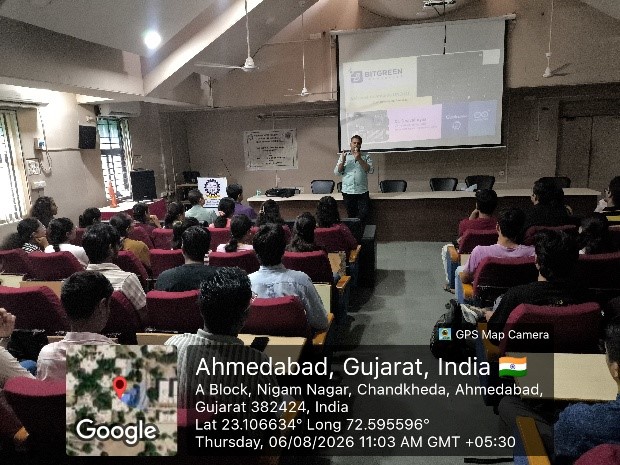
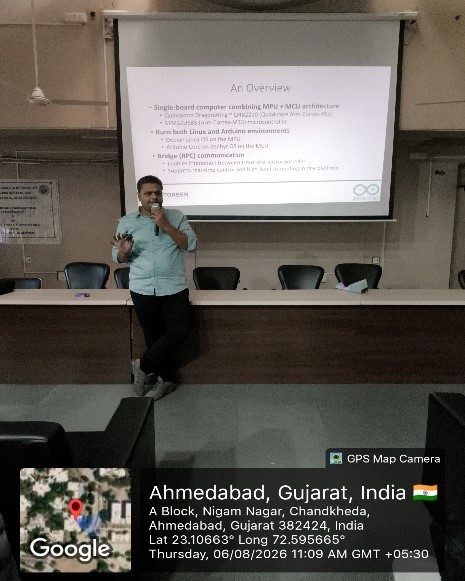
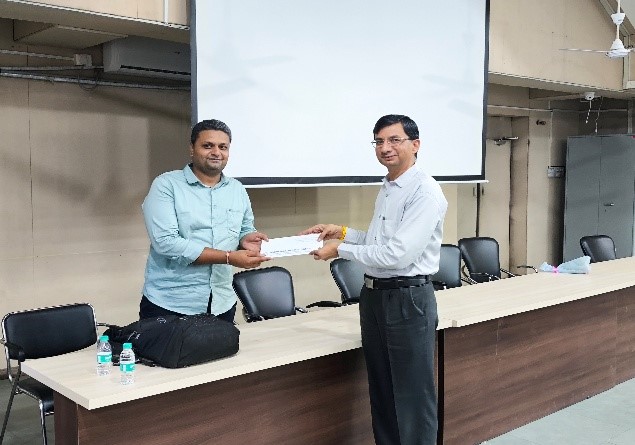
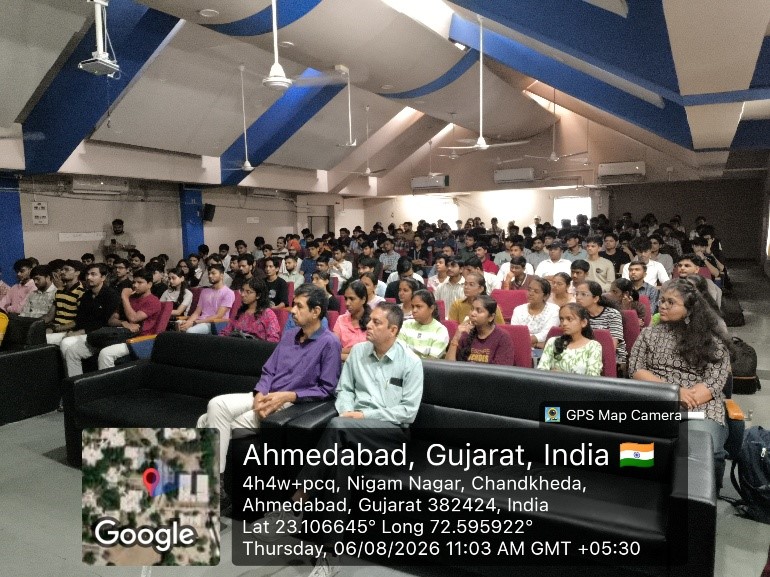
The Department of Electrical Engineering at Vishwakarma Government Engineering College (VGEC), Chandkheda, under the IEI Student Chapter, organised an expert lecture titled “Edge AI using Arduino UNO Q” on 6th August 2026, at the A-Block Auditorium. The session witnessed enthusiastic participation from 170 students of the 4th semester, Electrical Engineering Department. The program began with warm and encouraging remarks by Dr H. D. Mehta (Professor, Electrical Engineering), who motivated students and created awareness about the latest trends and emerging opportunities in the field of Artificial Intelligence and Arduino. The expert speaker, Dr Dhaval Vyas (Embedded Firmware Developer at Bitgreen Technolabz Pvt Ltd), commenced the lecture by introducing on implementing Artificial Intelligence (AI) and Machine Learning (ML) capabilities directly on an edge device rather than relying entirely on cloud-based computing. The Arduino UNO Q combines microcontroller-based control with embedded computing capabilities, making it suitable for developing smart and intelligent applications. The session introduced participants to the concepts of Edge AI, real-time data processing, sensor interfacing, AI model deployment, and intelligent decision-making at the device level. It also highlighted applications such as smart automation, predictive maintenance, robotics, industrial monitoring, and IoT-based systems.

Key Features:

  • Organizing Department: Electrical Engineering
  • Expert: Dr Dhaval Vyas  (Embedded Firmware Developer at Bitgreen Technolabz Pvt Ltd )
  • Date: 6th August 2026
  • Venue: A-block Auditorium, VGEC
  • Number of Participants: 170
  • Coordinators:  Prof. M.L.Patel and Prof. N.B.Lodha 

Key Points Discussed:

  • Concept, architecture, advantages, and applications of processing AI workloads locally. 
  • Overview of its architecture, features, processing capabilities, and suitability for AI-based applications. 
  • Understanding how ML models can be executed locally for real-time decision-making. 
  • Integration of Edge AI with connected devices and IoT systems. 
  • Reduced latency, lower bandwidth requirements, improved privacy, and greater reliability. 
  • Demonstration of AI-based data processing and intelligent decision-making using the Arduino UNO Q platform. 

Outcome:

  • Understand the fundamental concepts of Edge AI and Edge Computing.
  • Explain the features and capabilities of Arduino UNO Q for intelligent embedded applications. 
  • Understand the process of acquiring and processing sensor data at the edge.
  • Gain basic knowledge of deploying AI/ML models on edge devices. 
  • Develop an understanding of real-time AI-based decision-making without depending completely on cloud services. 
  • Identify suitable industrial and IoT applications of Edge AI. 
  • Understand the benefits of Edge AI in terms of latency, bandwidth, privacy, and reliability. 
  • Develop awareness of emerging technologies combining AI, embedded systems, IoT, and automation. 

Glimpses